Council seeks views for Highland-wide Gaelic language designation
Highland Council says it is looking to engage with communities on whether to make the entire local authority area an Area of Linguistic Significance (ALS).
The Scottish Languages Act allows for an ALS to be established in places where Gaelic is spoken by a significant proportion of the population, or where there are important historical and cultural links.
But critics argue that applying the designation across all of Highland would weaken the purpose of the legislation, which was introduced to support communities where language remains strongest, such as Skye and Raasay.
Highland Council’s Gaelic Committee met this week. It agreed to move forward with a framework to hold a consultation in September.
Màrtainn Mac A’Bhàillidh from Comann nam Pàrant Port Rìgh is among those who have raised concerns. Speaking to Radio Skye, he said:
“It essentially duplicates something we already have which is a Highland-wide Gaelic language policy. We’ve had Gaelic Medium Education (GME) in the Highlands for 40 years. We’ve had the Gaelic language plan in place since 2005/6. They’ve taken a Highland-wide approach to date.
“The whole idea of introducing the Scottish Languages Act and Area of Linguistic Significance was to make policy more granular, to support the Gaelic speaking communities and do more where more can be done. We see this as making a total mockery of the Scottish Languages Act.
“We’ve all wasted four years getting to this point. If Highland Council goes ahead and duplicates their existing Gaelic Language Plan then we’re just no further forward. We’re back to where we started.”
There are 18,552 people in the Highland Council area with Gaelic skills, according to the latest census.
Eilean a’ Cheò (Skye and Raasay) is the only electoral ward within the Highland Council area which has over 20 per cent of the population with Gaelic skills.
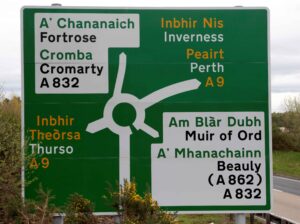
Skye Councillor Drew Millar is the Chair of the Gaelic Committee. He told Radio Skye:
“Here on Skye we have already ticked all the boxes that the Government want to see in an Area of Linguistic Significance. What we’ll do with Skye is keep supporting and promoting Gaelic and trying to encourage more people to use the language, not just in schools but for use in the whole community. We’ll be looking at how we can boost the economy here in Skye too.
“The consultation process doesn’t start until September and will run for 12 months. We’ll be talking to Comann nam Pàrant, working together consulting with the general public, and hopefully we’ll come to a very amicable solution that will be accepted by Bòrd na Gàidhlig and by the Scottish Government, and will allow Skye to move forward.”
Gaelic and Scots were recognised as official languages by the Scottish Government last November. Former MSP for Skye, Kate Forbes was one of the main advocates for the legislation which came into effect in 2025.
Raasay Councillor Chrissie Gillies also sits on the Gaelic Committee. Speaking to Radio Skye, she said:
“This has been misunderstood, which is really unfortunate. This is not the Highland Council saying, ‘we are doing one huge big area’. That is not what is being proposed at all.”
Councillor Gillies went on to say the local authority is considering all options.
“Everything is on the table. The whole point of this paper which went through was to say, ‘right, we’re going to look at all of Highland’ because it all counts and let’s hear from everybody and see what everybody is wanting to have happen moving forwards.”
Councillor Gillies says she has receieved online abuse in the past week.
“Whether it is misunderstanding or misinformation, it doesn’t matter, the outcome is the same. It’s not actual discussion. It’s got to the stage of being really, really abusive and harrassing. I have absolutely no intention of being trolled online.
“This is why I blocked accounts. I’m not engaging like that. I will talk to everybody, I think everybody is aware of that. It’s having a discussion or a debate, whatever you want to call it, to look at what’s going on. For the council, this is the starting point.”
Responding to Councillor Gilles’, Màrtainn Mac A’Bhàillidh said:
The Council says it will begin to take views on the recommendations made to the Gaelic committee later this year.
The local authority says a consultation will follow if the Council decides to proceed with a proposed designation.
A Highland Council spokesperson said:
“It’s important to note that no decision on ALS designation has been made.
“The report before the Gaelic Committee this week sought agreement to take forward a framework for public engagement and consultation. The purpose is to gather the views of all our communities, their specific local context and their needs relating to Gaelic.
“The outcome of community engagement will inform the final approach to designation and that will then be submitted to the Scottish Government.
“Formal consultation and structured engagement will begin when the statutory consultation period begins in September 2026.
“The forthcoming consultation will provide a consistent, transparent and equitable opportunity for all stakeholders to consider and respond to the proposals.”
The Scottish Government has put forward £1.5 million to support the ALS process across the country.
Cabinet Secretary for Education, Culture and Gaelic Màiri McAllan said:
“The Scottish Government welcomes Highland Council’s interest in and engagement with the provisions of the Scottish Languages Act. We also note the high level of positive community interest in the issue of areas of linguistic significance.
“We recognise this is a process with key steps for authorities, for Bòrd na Gàidhlig, for communities and for the Scottish Government. We are committed to working with all partners to ensure this process is implemented in a way that supports and strengthens Gaelic communities across the Highlands.”
Listen to the full interview with Màrtainn Mac A’Bhàillidh below.
Listen to the full interview with Councillor Chrissie Gillies below.
]]>